Access, abundance and the last drill
In Addendum, Fresco treats planetary resources as a common inheritance. Imagine ten households that each need a drill twice a year. A local access center could stock high-quality drills, batteries and spare parts. Sharing can reduce the number of tools required and keep maintenance in one place.
If everyone requests the same drill after a storm, a queue still forms. Restricted sale of available goods and a genuine shortage of tools have different causes. Measure waiting time, travel distance and repair turnaround to see who actually gains access.
Jacque Fresco · resource-based economics · Fresco · Designing the Future (PDF)
What can a sensor decide?
Cybernation is Fresco’s term for using measurements and automated feedback to coordinate production and delivery. TVP describes “arriving at decisions” by checking physical conditions. Soil moisture, water reserves, electrical load and requests for food signal when to change an allocation. Dynamic equilibrium means adjusting as both demand and supply change.
Suppose a town requests irrigation water during a drought. A meter can show the available volume. Residents and neighboring communities must establish drinking-water priorities, minimum river flow and a way to contest faulty readings. Centralized sensing and transparent reporting still leave those choices open.
TVP · sensors and decisions · Moving Forward · speaker-labelled transcript (reproduction)
Try the student allocation model
Which circular city is on screen?
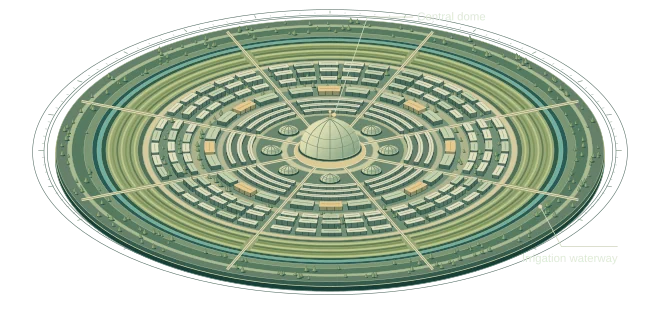
In “Project Earth,” Joseph describes a city with industrial and energy belts, nearby automated farms, and electric transit connecting districts. Fresco’s models and animations make the relationships visible. The published TVP layout puts communications, health and education in a central dome, with access and research nearby, then cultural spaces, housing and gardens. Farms, a waterway and recreation occupy the outer areas.
TVP proposes prefabricated homes designed for fire and storm resistance, plus indoor hydroponic and aeroponic farms. These feed roots with a nutrient solution or a mist. Performance would depend on materials, local hazards and maintenance. In the film, public electric trams and maglev coexist with automated personal vehicles. The design aims to reduce collisions and congestion. A drawing cannot supply an accident rate.
Moving Forward · speaker-labelled transcript (reproduction) · TVP · published circular city layout · TVP · transportation concepts · TVP · dome construction and tours
Open the eight-zone city explorer
Energy follows geography
The film combines solar, wind, geothermal and heat-difference generation with tidal or wave energy where geography permits. Storage and connections between sources would help meet demand when one source falls short. A coastal city and an inland city would have different options.
A student can compare a week of hourly demand with a week of output and mark every hour that needs storage, imports or lower consumption. Counting installed generating capacity alone would miss those hours.
Moving Forward · speaker-labelled transcript (reproduction) · TVP · energy proposals
Repair, recycling and regional networks
The engineering proposal replaces frequent disposal with modular upgrades, open designs and recovery of materials. For a failed water pump, interchangeable bearings, instructions and a stocked replacement seal could allow the workshop to return an entire assembly to service. “Indestructible” and complete recycling are design ambitions. Wear, mixed materials and the energy needed for recovery still count.
TVP extends the idea to long-distance maglev networks, marine farms and sea platforms that retrieve pollution. For a related classroom exercise, sketch a freshwater aqueduct connecting two basins. Compare the pumping energy, available water in a dry month and consequences for people downstream before counting any water as transferable.
Fresco · Designing the Future (PDF) · TVP · transportation concepts · TVP · cities in the sea
Education, conditioning and crime
Fresco argues that the conditions people grow up in shape what they learn to value. The films envision education built around inquiry, empathy, cooperation and working across disciplines. Compare two classroom workshops. In one students compete for the only diagnostic instrument. In the other they share the tool and earn credit for explaining their repairs. What changes in their behavior would you look for?
In Moving Forward, Peter Joseph predicts a roughly 95% decline in crime under an RBE. The line is his narration. Fresco’s interview describes redesigning environments. Evidence about how stress or support affects risk does not establish a percentage for a society-wide change.
Moving Forward · official release · Moving Forward · speaker-labelled transcript (reproduction) · CDC · risk and protective factors
Find the speaker and examine the prediction