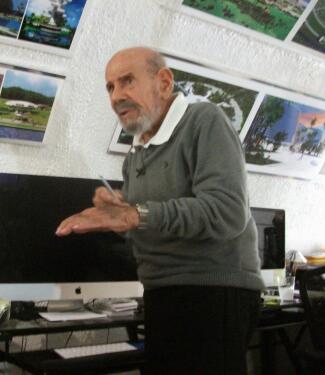
Fresco and Roxanne Meadows enter the trilogy here. After examining banks and development loans, Joseph gives them the floor to explain how access to goods could work without money.
Fresco at a research-center tour in 2014, six years after the film. Photo credit.
Part I
Fractional-reserve banking
Joseph uses the Federal Reserve Bank of Chicago’s historical workbook Modern Money Mechanics to explain bank lending. He argues that creating principal without simultaneously creating interest makes widespread default and poverty mathematically inevitable.
Reading the evidence
A commercial bank normally creates a matching deposit when it makes a loan. Money already in circulation can change hands repeatedly and pay interest. Debt outstanding is a stock measured at one moment. Interest payments are flows over time. The workbook’s illustrative reserve multiplier also predates the Fed’s March 2020 move to zero reserve requirement ratios.
John Perkins, author of Confessions of an Economic Hit Man, recounts how he says inflated project forecasts, large loans and contracts for foreign firms put countries under pressure. He connects debt to demands for privatization, access to resources and political concessions.
Reading the evidence
Perkins is an interview witness making a broad allegation. IMF programs have documented conditions. The World Bank publishes agreements and project evaluations. For a named project, compare the signed terms, the forecast, who received the contracts and who bore the losses. A loan condition by itself cannot establish a secret motive.
Fresco argues that political debate and legislation cannot by themselves produce food, housing or energy. He and Meadows present a proposed system in which a resource survey, automated production and access centers supply people directly. They give engineering choices a central role in social design.
Reading the evidence
Fresco’s own definition treats Earth’s resources as a common inheritance and describes access without money, credit, barter or debt. The remaining engineering question is practical. If two communities request the last available pump, who sets the priority and who can challenge it?
The closing section draws on Jiddu Krishnamurti’s reflections on conditioning and asks viewers to change habits and participate in a movement. Joseph’s film helped bring supporters together around the proposed economy.
Reading the evidence
A 2009 movement orientation guide describes The Zeitgeist Movement as TVP’s activist arm at the time. That wording belongs to a dated relationship. The subsequent separation matters when assigning later material to either organization.
Can a borrower pay interest that the original loan did not create?
Use the worked example below to trace one deposit. The borrower’s ability to earn income and the lender’s decision to spend are explicit assumptions. In a real economy a borrower can still lose income or default.
Trace the four transactions
Suppose there is one bank and one borrower. The bank buys a small service from that borrower. Each row is the next transaction in the same example.
After the $5 interest payment, what would let the borrower repay the original $100?
Community
Discuss this page
Comments, notes and votes come from other readers. They are not written or checked by this atlas or by The Venus Project. Choose as little or as much as you like. Nothing from another website loads until you press a button.
Reply or review
Answer the page as a whole, such as a review or a counter-proposal. Reading needs no account. Posting needs a free GitHub account.
Challenge or add to one specific claim, with a source attached. Select text on the page. Reading needs no account. Posting needs a free Hypothesis account.