An interview-led film moves from human development to a thought experiment about designing a city. Neuroscientist Robert Sapolsky, physician Gabor Maté and Fresco appear. Joseph narrates the links between their contributions.
Sapolsky, Maté and other interviewees explore how biology, early experience, stress and social conditions interact. The film challenges the idea that greed, addiction or violence follows inevitably from a fixed human nature.
Reading the evidence
Research describes risk and protective factors. Deprivation or chronic stress can raise risk while stable relationships can be protective. Neither a gene nor a childhood circumstance predicts a particular person’s conduct by itself.
Joseph argues that dependence on sales and wage income rewards turnover and can encourage deliberately short product lives, restricted supply and ecological damage. He uses private ownership and the pressure for continual economic growth as examples.
Reading the evidence
GDP measures economic output. It does not directly measure repairability, well-being or ecosystem health. To test planned obsolescence in a product, inspect the failure, spare-part availability, repair instructions and sales incentives. Intent requires more evidence than a single early failure.
Joseph asks viewers to imagine an Earth on which a society can start from scratch. First inventory resources, then estimate needs, plan extraction within limits and coordinate production. The film applies this sequence to agriculture, energy, transport and circular cities. Fresco’s designs and interviews are part of the presentation.
Reading the evidence
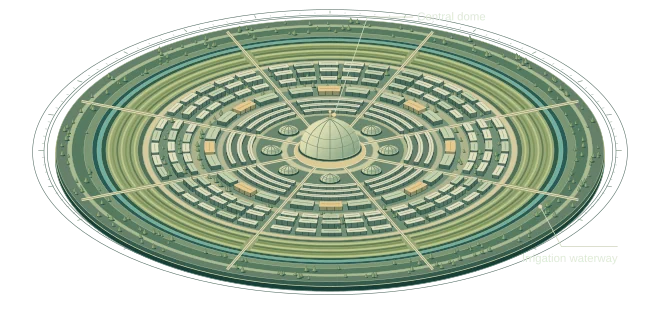
The sequence describes how a system might work. Its industrial and energy belts belong to the screen example. The published TVP city plan describes a different sequence of surface uses. A model or animation can show a layout while leaving throughput, reliability and consent to be demonstrated.
The final part warns that debt pressure, growth incentives and ecological damage could destabilize society. Its dramatized climax shows public unrest and people collectively discarding money.
Reading the evidence
The protest sequence stages an imagined outcome. Environmental pressure can be examined with observations. UNEP’s 2024 materials assessment, for example, tracks changes in extraction. Those data cannot date a collapse or establish the ending depicted in the film.
In the “Victims of Culture” sequence, Peter Joseph’s narration predicts roughly a 95% fall in crime if money disappears and basic needs are met. Fresco speaks later about changing the social environment. The number is a forecast in the film. A prison census counts people in custody by offense and jurisdiction. It cannot measure the global causal effect of a hypothetical economy.
Define the offenses, place, time period and baseline. Record incidents, reporting rates and access to essentials. A comparison would need to account for other changes, including policing and laws. A global percentage needs a method that works across jurisdictions.
Whose voice makes the numerical prediction about crime?
Community
Discuss this page
Comments, notes and votes come from other readers. They are not written or checked by this atlas or by The Venus Project. Choose as little or as much as you like. Nothing from another website loads until you press a button.
Reply or review
Answer the page as a whole, such as a review or a counter-proposal. Reading needs no account. Posting needs a free GitHub account.
Challenge or add to one specific claim, with a source attached. Select text on the page. Reading needs no account. Posting needs a free Hypothesis account.